
A few hours ago I came across something that immediately made me stop scrolling. Somebody is rebuilding Adobe Lightroom. Not making another photo editor that technically opens RAW files. Not making some stripped-down browser app. Actually trying to rebuild Lightroom.
And Photoshop.
And Premiere.
And Illustrator.
And After Effects.
And Acrobat.
And InDesign.
Except they're open source, they're being built in Rust (if you know coding language), and apparently AI is helping one developer move through this at a completely absurd pace. The Lightroom alternative is called LightCraft, and this might be one of the more interesting uses of AI I've seen in a while.
So What Is LightCraft?
LightCraft is part of a larger project called ArtCraft.
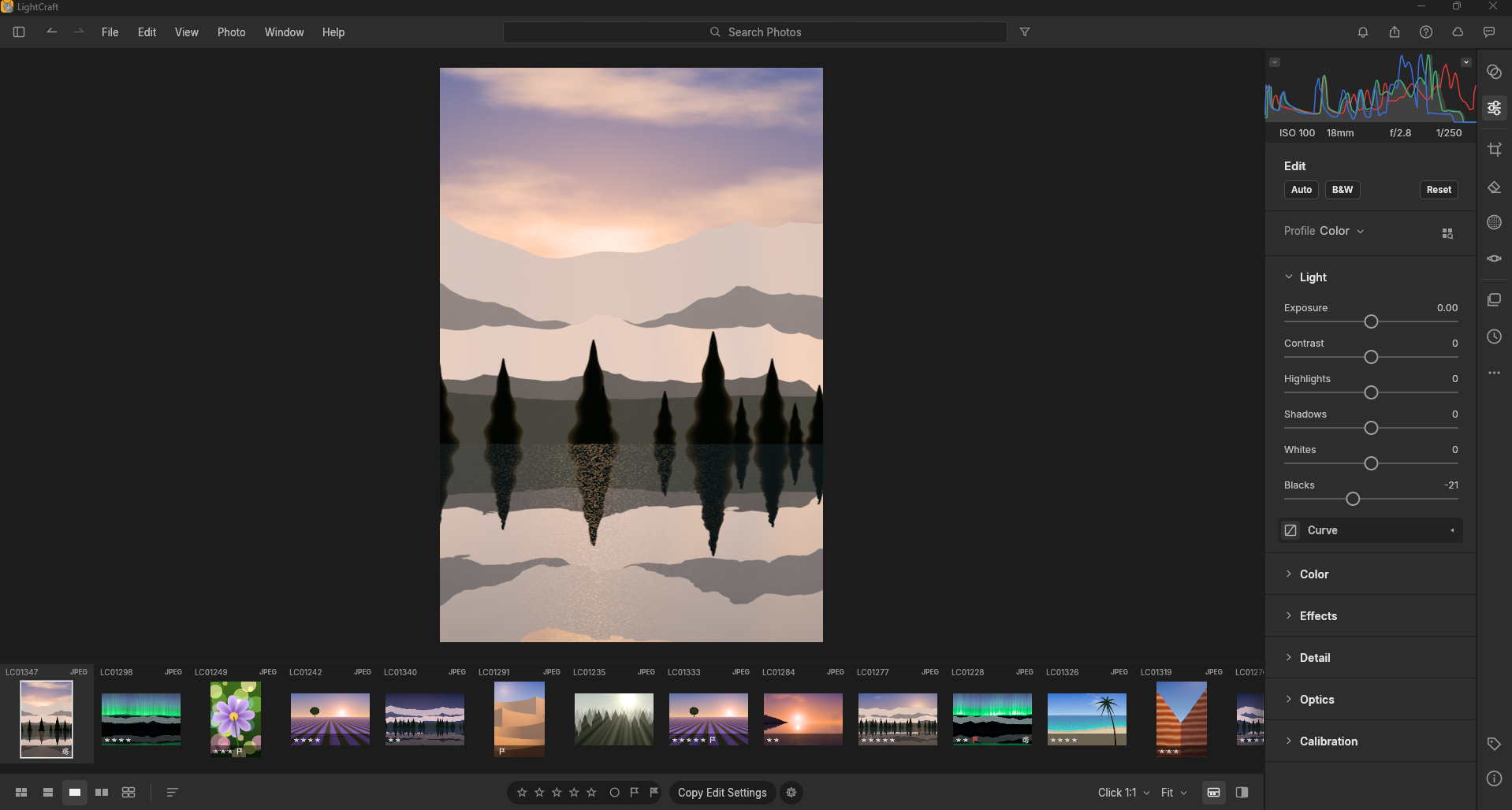
This is a screenshot of Lightcraft (this isn’t Lightroom CC)
The suite currently includes:
PhotoCraft — Photoshop alternative
VectorCraft — Illustrator alternative
FilmCraft — Premiere alternative
LightCraft — Lightroom alternative
PdfCraft — Acrobat/PDF alternative
EffectCraft — After Effects alternative
DesignCraft — InDesign alternative
These aren't skins sitting on top of Adobe products. The ArtCraft team describes them as open-source applications rebuilt from scratch in Rust, with desktop builds for Windows, macOS, and Linux. Several can also run through WebAssembly in a browser.
PetaPixel reported that software engineer Brandon Thomas has been using Anthropic's Opus AI while building the applications. Thomas is also very specifically not presenting himself as some dude who discovered AI coding three weeks ago. He's a longtime software engineer who has worked on large-scale systems and has extensive experience with Rust.
That distinction matters.
Because this isn't:
"I asked AI to make Lightroom."
And three prompts later we have Lightroom. It's an experienced developer using AI as a multitool.
And that is the part I find interesting.
This Is the Kind of AI I Actually Want
There are about twelve million conversations happening right now about AI replacing artists. I am significantly more interested in AI helping artists replace shitty software ecosystems.
Give a competent developer the ability to research faster, prototype faster, write boilerplate faster, test faster, document faster, and have multiple coding agents chewing through different pieces of a project simultaneously?
Now we're talking.
The LightCraft roadmap specifically describes development being driven continuously by several parallel AI agents. The project is tracking Lightroom functionality feature-by-feature and gradually working toward Lightroom parity, followed by the additional modules found in Lightroom Classic.
That is a very different use of AI from:
"Make me a picture of a cyberpunk woman standing in the rain."
AI doesn't necessarily have to be the thing creating the art. AI can help us build the paintbrush, and potentially make that paintbrush free.
Let's be Real, Adobe Has Us by the Balls
If you've worked professionally in photography for any meaningful amount of time, you probably know exactly what I mean.
Lightroom works.
Photoshop works.
Premiere works.
There is a reason these programs became industry standards. I'm not going to pretend Adobe makes terrible software because I don't like paying for it. Somewhere along the way we reached a point where an enormous percentage of the creative industry became dependent on one company's subscription ecosystem. You don't buy Lightroom anymore, you rent access to Lightroom. And sure, there are already alternatives.
Capture One exists.
Darktable exists.
RawTherapee exists.
Affinity has become a legitimate Photoshop competitor. DaVinci Resolve is arguably one of the strongest examples of a program successfully breaking Adobe's grip on part of the creative industry. Though, Lightroom is particularly difficult to replace because Lightroom isn't just a RAW editor.
Cataloging
Culling environment
Presets
Ratings
Color workflow
Metadata
Batch processor
Masking system
Exporter
After years of working inside that environment, replacing Lightroom means replacing an entire workflow. That is a much bigger problem than recreating an Exposure slider. LightCraft seems to understand that.
For Nightlife Photography, Workflow Is Everything
This is where I start caring about this beyond: "Oh cool, somebody cloned Lightroom." Anybody who regularly shoots clubs, concerts, raves, or events knows that editing the individual photo isn't always the difficult part. It's everything around it. You come home with hundreds or thousands of images. The lighting changed twelve times in thirty seconds. Half the room is purple, then it's red etc. Now you've got 15 nearly identical photos of somebody behind the decks and you're trying to figure out which one has the sharpest eyes at 1AM.
So what do I actually need?
I need to import a massive shoot
Move through images quickly
Flag the good ones
Reject the garbage
Rate things
Apply a base grade
Sync that grade across a sequence
Correct white balance because the venue decided human skin should apparently be magenta.
Adjust exposure
Reduce noise
Crop
Export a ton of images
LightCraft already has a surprising amount of that workflow built. Its current feature list includes albums and folders, ratings, flags, labels, search, sorting, Compare and Survey views, presets, virtual copies, edit history, synchronized settings, batch exporting, XMP sidecars, masking, curves, color grading, HSL-style color controls, sharpening, noise reduction, crop tools and the usual exposure controls.
And the developers have clearly thought about speed.
The library grid is virtualized for large collections, RAW previews are prefetched while you're moving through a shoot, rendering is GPU accelerated where supported, and the software has already been tested with libraries containing tens of thousands of photos. Nobody wants their catalog choking because they imported 2,000 photos from Saturday night.
And Then There Is the Size
LightCraft:
144 MB.
The Lightroom Classic installation sitting on my computer:
4.98 GB.
I don't currently have Lightroom Creative Cloud installed, so I'm only comparing it with Classic here.
That's roughly 35 times the size.
Is application size by itself a measurement of which program is better? Obviously not. Lightroom contains years and years worth of functionality, camera support, libraries and additional components that LightCraft simply doesn't have yet. The developers say Lightcraft runs locally, requires no account, and doesn't require a subscription.
FYI: I Wouldn't Replace Lightroom With It "Yet"
This is where I'm going to ruin the fun, a little. LightCraft is very new.The developers themselves estimate that, by raw feature count, they're somewhere around 79% of Lightroom.
But they make a much more important distinction:
If you're asking whether a working photographer could actually replace Lightroom today without noticing the difference? They estimate they're closer to 60–70% there.
There are some massive caveats:
Camera color calibration still needs work.
Lens profiles aren't finished.
AI denoise isn't finished.
The more advanced AI masking tools aren't finished.
HDR editing isn't finished.
Some Lightroom Classic modules aren't there.
Camera support is still uneven.
There is one problem in particular that makes switching impossible for me right now. LightCraft currently recognizes CR3 files and can display their embedded previews, but full CR3 RAW decoding is still being worked on. The roadmap actually lists CR3 support as one of the project's highest priorities.
But Look at What's Already Here
This is why I'm still excited.
LightCraft already supports substantial parts of the editing pipeline:
Exposure
Contrast
Highlights
Shadows
Whites
Blacks
Temperature
Tint
Curves
Color mixing
Color grading
Texture
Clarity
Dehaze
Vignette
Grain
Black and white
Presets
Masks
Heal and clone
Noise reduction
Batch export
Ratings
Flags
Albums
Virtual copies
XMP
Syncing edits across multiple photos
This isn't a weekend coding experiment. That's the beginning of an actual photography application.
Adobe Should Still Pay Attention
LightCraft doesn't need to replace Lightroom tomorrow to matter. One of the coolest parts is what projects like this show. The cost of building complicated software is changing. A small team, or potentially one extremely experienced developer can now attempt projects that previously would have required an entire software company.
That's insane.
And if open-source developers can increasingly build competent alternatives to software that creative professionals have been renting for years, companies like Adobe are going to have to give people better reasons to keep paying.
Competition is good.
Open source is good.
Tools artists actually own are good.
AI helping talented developers build those tools faster?
I'm completely here for it.
So Am I Switching?
No.
My CR3 files basically made that decision for me, but I'm installing LightCraft. I'm testing it and I'm watching the roadmap. When proper CR3 support, accurate Canon color profiles, dependable masking and better denoise arrive, I'm going to start throwing actual nightlife shoots at it.
Lastly, If AI helps build the tools that eventually let photographers stop paying Adobe forever…
That might be one of the best things anyone has done with it.
Further reading: PetaPixel's original report · LightCraft on GitHub · LightCraft development roadmap